

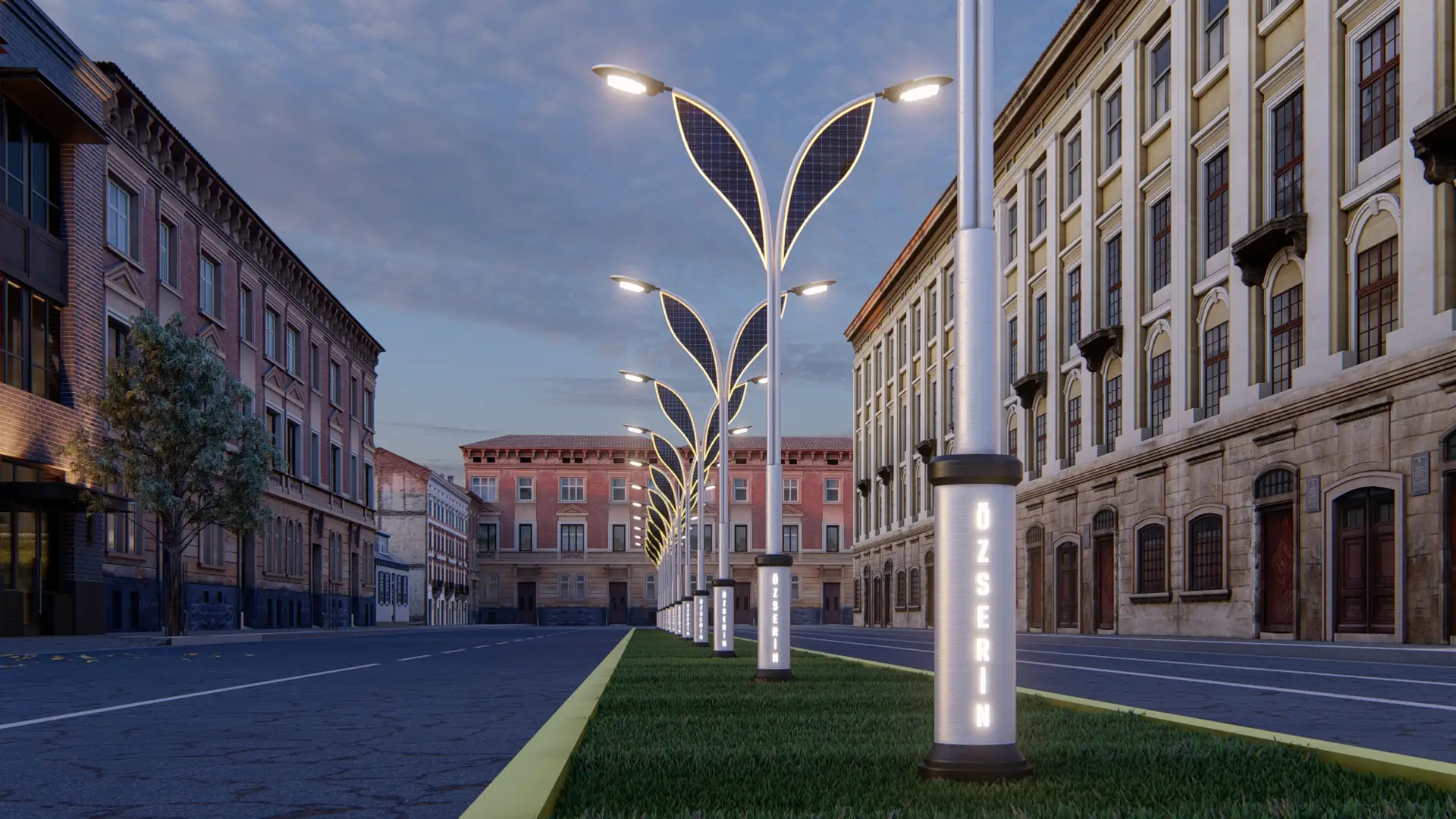
1. Determine how the area is used
The first question is who uses the area. Footpaths and parks call for low, warm light on a human scale, whereas streets and boulevards require taller poles and a wider light distribution for vehicle traffic. In squares and car parks, the aim is to light the entire area uniformly.
In Europe, road lighting is classified according to the EN 13201 standard: roads for motorised traffic are defined by M classes, pedestrian and low-speed areas (including pedestrian squares) by P classes, and conflict areas (junctions, roundabouts, pedestrian crossings, car park entrances) by C classes. The target class determines the required lighting level and, consequently, the choice of pole and luminaire.
2. Choose the pole height
Pole height is considered together with the width to be lit and the desired atmosphere. The ranges used in practice are shown below; the wider the road, the taller the pole.
| Area | Typical pole height | Note |
|---|---|---|
| Garden, landscape, walkway | 0.5–1.2 m (bollard) · 3–4 m | Glare-free light at eye level |
| Park path, pedestrian route within a residential complex | 3.5–5 m | Decorative or classic lighting pole |
| Residential complex road, car park access road | 5–7 m | Single-sided arrangement is usually sufficient |
| Street and boulevard | 8–10 m | Staggered or opposite, depending on width |
| Square, large car park, junction | 6–12 m and above | High-mast lighting pole or floodlight solution |
3. Plan the spacing and arrangement
Pole spacing is generally 3 to 4.5 times the pole height: about 3.5 times on streets, 4 times on residential complex roads and 4–4.5 times on park paths. If the road width does not exceed the pole height, a single-sided arrangement is used; up to 1.5 times the pole height, a staggered arrangement; and for wider roads, an opposite arrangement.
For a preliminary estimate specific to your project, you can use our project calculator; the exact spacing is confirmed by a photometric calculation based on the light distribution of the selected luminaire.
4. Choose the material to suit the climate and use
The most important factors determining a pole's service life are its material and surface protection.
- Steel: High strength at a reasonable cost; protected against corrosion by hot-dip galvanising with an electrostatic powder coating on top. Widely used for street and high-mast poles.
- Aluminium: Lightweight, rust-free and easy to shape; with extruded profiles, it is suited to modern and LED-integrated designs. Advantageous in coastal and humid regions.
- Cast aluminium: For classic and ornate forms; preferred in historic settings and park projects.
5. Choose the luminaire according to the lighting requirement
When choosing a luminaire, look not at the wattage but at the luminous flux (lumens), efficacy (lm/W) and optics (light distribution). Of two luminaires with the same power, the one whose optics direct the light onto the road achieves the same illuminance level with wider spacing.
Outdoor luminaires should have at least IP65 dust and water protection, and high IK impact resistance where there is a risk of vandalism. Compliance of the luminaire with the EN 60598 luminaire safety standard is frequently required in specifications.
6. Determine the colour temperature and colour
In historic settings and parks, 2700–3000 K warm white is the common choice; on streets and squares, 4000 K neutral white. In natural habitats, amber light reduces light pollution and the attraction of insects to light. The colour of the pole shaft can be selected from the RAL chart to suit the project.
7. Consider the foundation, installation and maintenance
The pole is fixed with anchor bolts to a concrete foundation suited to its height, the wind load and the ground conditions. A service door in the pole shaft for the cable entries, fuse and junction box makes maintenance easier. In areas where running a power line is difficult or expensive, solar lighting poles eliminate excavation and cabling costs.
Project calculator Free
Calculate right away how many poles your project needs.