

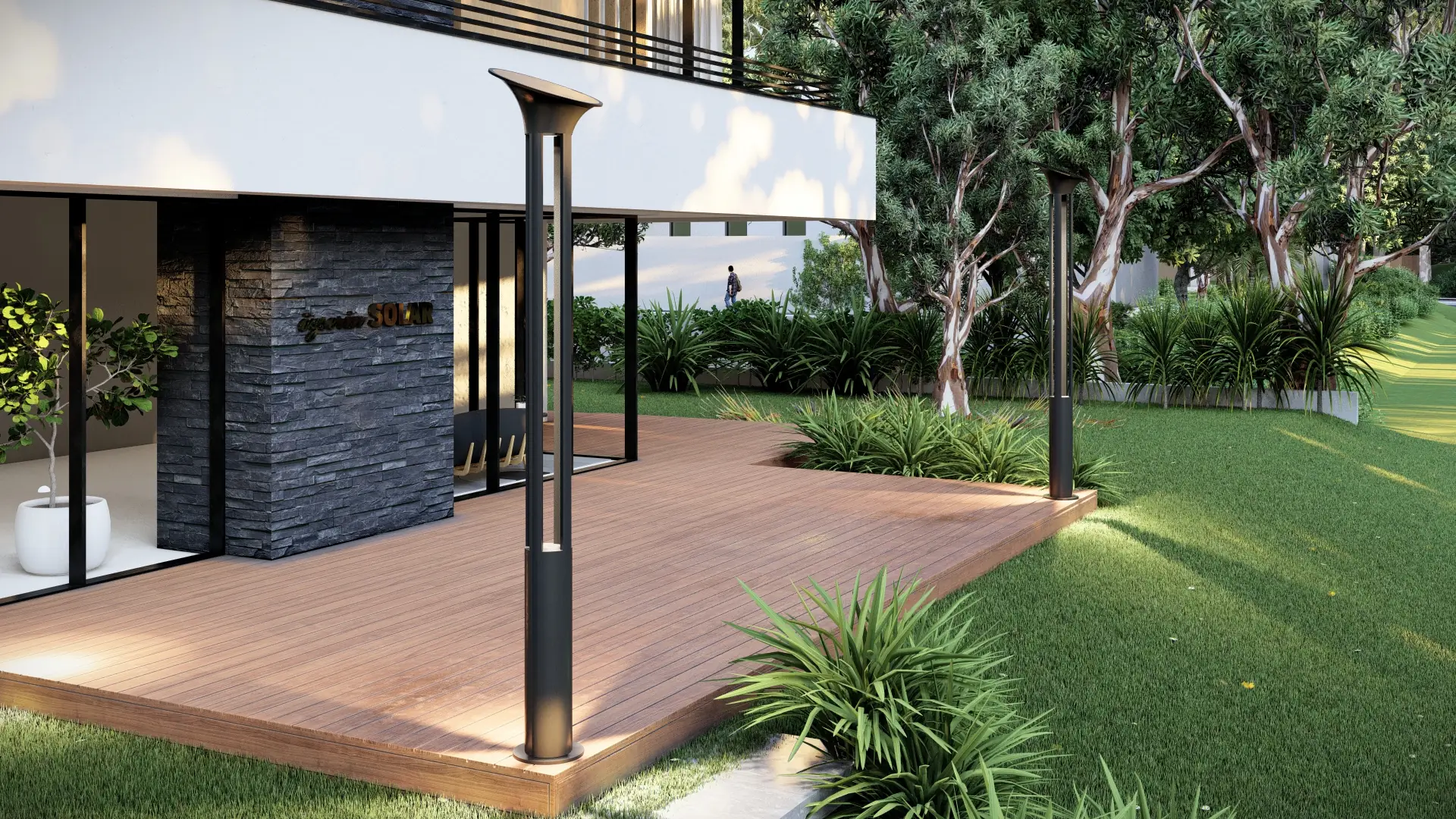
Components of the system
- Solar panel: Usually has monocrystalline cells, which deliver higher efficiency per unit area. The panel is positioned to face south at the correct angle.
- Battery: Current systems use LiFePO4 (lithium iron phosphate), which stands out for its long cycle life, high temperature resistance and safe chemistry.
- Charge controller: An MPPT controller draws maximum power from the panel and protects the battery against overcharging and deep discharge.
- LED luminaire: High-efficiency LEDs deliver high luminous flux with little energy; programmed dimming throughout the night saves energy.
- Pole and arm: Designed to carry the weight of the panel and the wind load; the panel can be integrated into the pole body or mounted on an arm.
The day and night cycle
During the day, the panel transfers the energy it generates to the battery via the charge controller. At dusk, the system detects the drop in panel voltage and switches the luminaire on automatically; in the morning, it switches off in the same way. After midnight, when traffic decreases, the light is dimmed to conserve battery energy; on models with a motion sensor, the light returns to full power when someone approaches.
How many nights does it run? The concept of autonomy
Autonomy is the number of nights the battery can run the system without receiving any sunlight. To cover overcast and cloudy days, systems are generally sized for 2–3 nights of autonomy. Because days are shorter and nights longer in winter, sizing is based on the worst month.
Basic sizing
The calculation below is intended only as a rough guide; in an actual project, solar irradiation data, panel angle and shading are assessed together.
| Step | Formula | Example (30 W luminaire) |
|---|---|---|
| Nightly consumption | Power × operating hours (including dimming) | 30 W × 12 hours × 60% average = 216 Wh |
| Battery capacity | Nightly consumption × autonomy ÷ usable fraction | 216 Wh × 3 nights ÷ 0.9 = approx. 720 Wh |
| Panel power | Nightly consumption ÷ (sun hours × system efficiency) | 216 Wh ÷ (3 hours × 0.75) = approx. 100 W |
Advantages and points to consider
- No excavation, cable ducts or grid connection required; installation is quick and there is no electricity bill.
- Unaffected by power cuts; ideal for parks, rural roads, coastal areas and campuses.
- The panel must not be shaded during the day; shade from trees and buildings reduces efficiency.
- On busy main roads that require high lighting levels, mains-powered systems may be more suitable.
Maintenance
Keeping the panel surface free of dust and dirt preserves its efficiency; in dusty regions, cleaning several times a year is recommended. LiFePO4 batteries have a long service life, and when a battery reaches the end of its life, only the battery is replaced; the pole and luminaire remain in use.
Project calculator Free
Calculate right away how many poles your project needs.