

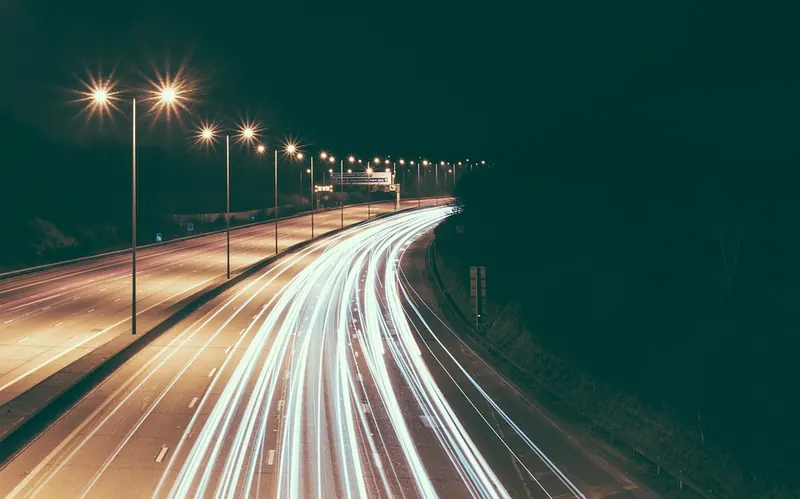
Today, the factors of utmost importance for traffic safety are enabling drivers to travel safely and increasing pedestrian visibility.
Looking at the general scope of the definition, road lighting is one of the general names given to lighting systems covering urban roads, main roads, motorways, expressways, ring roads, streets and avenues, link roads, junctions and other roads.
Road lighting, whose main purpose is to enable drivers to travel safely by increasing the visibility of pedestrians and other objects, must reliably provide the best possible visual conditions. For good road lighting, therefore, visual conditions should be improved with the needs of drivers in mind.
Properly designed road lighting resolves confusion in traffic and clears the way for urban traffic to flow smoothly. By resolving the complexities of traffic, road lighting also helps people feel safe.
Glare is also one of the most important factors in a good road lighting system. This is because direct glare from luminaires can impair drivers' visual performance and significantly reduce the visibility of hazardous objects on the road.
Studies report that improvements made where road lighting is poor have prevented 30–35% of traffic accidents.
Road lighting systems generally use high-pressure sodium vapour lamps, metal halide lamps and LED street luminaires. In this respect, LED street luminaires are more widely preferred for their service life and luminous efficacy.
Depending on the width of the road, the lighting poles used for road lighting are arranged in a single-sided, double-sided or staggered layout. Road lighting calculations also make use of computer software such as DIALux. Software such as DIALux has optimisation features for determining values such as the spacing between poles and the pole height. To use these features, limit values are usually entered into the program as inputs, and a calculation is then run to create the best lighting scenario within these values.
Another important benefit of using road lighting systems correctly is the potential for energy savings of up to 50%. In this respect, additional features such as remote management in particular help provide safe lighting over the long term while keeping operating and maintenance costs to a minimum.